



15 Dog Enrichment Ideas That Actually Tire Out Your Dog
Your dog needs more than a walk around the block every day. Exercise takes care of the body, but mental stimulation does the heavy lifting when it comes to producing a calm, well-behaved dog that doesn't destroy your house out of boredom. And bored dogs are creative. They'll redesign your couch cushions. They'll excavate your garden. They'll bark at absolutely nothing for forty-five minutes while you slowly lose your mind.
Dog enrichment gives your pet a way to use their brain and their natural instincts to burn through energy that a leash walk barely touches. Veterinary behaviorists and professional trainers have been beating this drum for years: twenty minutes of focused nose work can tire a dog out the same way a full hour of walking does. Anyone who has watched their dog collapse into a dead sleep after a training session has seen this play out in real time.
Below are 15 dog enrichment activities organized by the type of stimulation they provide. Most of them cost nothing and take minutes to set up.
Nose Work and Scent Games
A dog's sense of smell falls somewhere between 10,000 and 100,000 times more powerful than ours. Scent-based enrichment taps into that biological advantage and gives dogs a job that satisfies them on a level that fetch never will.
1. The Muffin Tin Puzzle
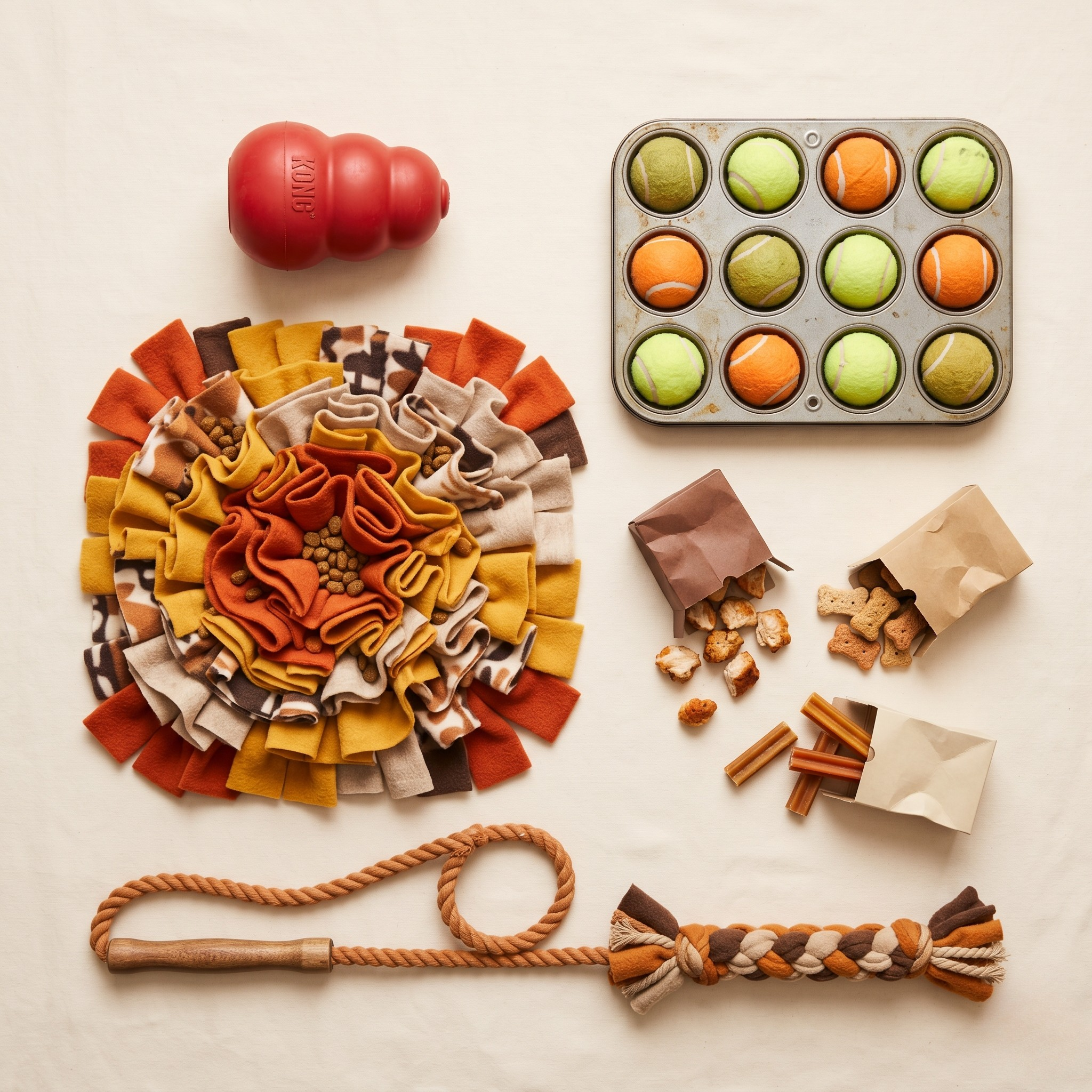
Drop small treats into a few cups of a regular muffin tin, then cover all twelve cups with tennis balls. Your dog sniffs out which cups hold the goods and nudges the balls aside to claim them. Thirty seconds to set up. Works for any size dog. Most dogs catch on fast but never seem to get bored with it, because the treat placement changes every time.
2. Scatter Feeding in the Yard
Ditch the food bowl entirely for one meal. Toss a handful of your dog's regular kibble across the lawn and give them fifteen minutes to hunt down every last piece. No grass? Scatter kibble across a bunched-up towel on the kitchen floor instead. This one change transforms the most monotonous part of a dog's day into genuine mental stimulation.
3. Scent Trails Through the House
Drag a treat along the floor from one room to another, leaving a few pieces at the end as the payoff. Start short and straight. Over a few sessions, add turns, doorways, and furniture obstacles. Dogs that pick this up quickly can follow trails up staircases, around corners, and through three or four rooms without losing the track. This is entry-level nose work, and some dogs become obsessed with it.
Food Puzzles and Slow Feeders
Dogs that vacuum up dinner in ninety seconds are missing the single easiest dog enrichment opportunity available. Stretching mealtimes out keeps the brain engaged and can reduce digestive issues like bloating and gulped air.
4. Frozen Kongs
Stuff a rubber Kong with wet food, xylitol-free peanut butter, mashed banana, or plain yogurt. Stick it in the freezer overnight. A frozen Kong keeps most dogs busy for twenty to forty minutes. If your dog has never seen one before, leave it unfrozen the first few times. They need to learn that persistence pays off before you raise the difficulty.
5. Snuffle Mats
A snuffle mat is a fabric pad covered in long strips where you hide kibble or small treats. Dogs push their noses through the material to find each piece. The repetitive sniffing triggers calming responses in the brain, which makes snuffle mats especially useful for anxious dogs or dogs on crate rest after surgery. Snuffle mats are available at most pet supply stores, and they wash easily.
6. The Cardboard Box Buffet
Grab a few empty boxes and paper towel rolls from your recycling bin. Crumple newspaper inside, scatter treats throughout, and hand the whole pile to your dog. They will tear, dig, and shred their way through it with total commitment. Watch to make sure they aren't actually eating the cardboard, but the shredding behavior itself is natural. Dogs rarely get to express that instinct indoors, and it burns more mental energy than you'd guess.
Physical Enrichment and Movement
Mental and physical dog enrichment activities overlap more than most owners realize. Anything that forces a dog to think while moving provides a double hit of stimulation that wears them out fast.
7. DIY Backyard Agility
Skip the expensive equipment. Balance a broomstick on two buckets for a low jump. Hold a hula hoop upright for a tire jump. Drape a blanket over two chairs to create a tunnel. Walk your dog through the course with treats the first few rounds, then watch how fast they memorize the route and start running it on their own. Agility builds body awareness, confidence, and problem-solving skills all at once.
8. Flirt Pole Play
A flirt pole is a long stick with a rope and toy attached to the end. Think of a cat toy, but sized for a dog. It burns a shocking amount of energy in a small yard because dogs sprint, pivot, and leap to grab the lure. Flirt poles also double as impulse control tools when you train your dog to wait before chasing and release the toy on cue.
9. Swimming and Water Play
Dogs that enjoy water get access to a whole different sensory world in a cheap kiddie pool. Toss floating toys or treats into the pool and let them work out retrieval at their own pace. Swimming also works well for senior dogs with joint problems. It builds muscle without putting weight on sore joints the way running and jumping do.
Social and Environmental Enrichment
Dogs are social animals hardwired to explore. Their world gets measurably richer when they encounter new environments, new people, and other dogs in calm, positive settings.
10. Sniff Walks Instead of Fitness Walks
Most owners keep a tight leash and a fast pace, which drags the dog past everything interesting without letting them process a single bit of it. Try this: once or twice a week, let the dog lead. Stop when they stop. Let them investigate every fire hydrant, every patch of grass, every suspicious spot on the sidewalk for as long as they want. A slow thirty-minute sniff walk delivers more mental stimulation for dogs than a brisk power walk twice that length.
11. Rotating Toy Selection
Dogs lose interest in toys they see every day. Put about a third of the collection in a closet and swap them out weekly. When the old toys reappear, your dog reacts to them like they just came out of the packaging. Zero cost. Minimal effort. Noticeable difference in engagement.
12. Car Rides to New Locations
Drive to a different park, a pet-friendly store, or a neighborhood you don't normally visit. The flood of unfamiliar sights, sounds, and smells forces your dog's brain into a higher gear. Novel environments provide a type of stimulation that the same backyard routine simply cannot replicate.
Training as Enrichment
Training is not just about obedience commands. It ranks among the most effective mental stimulation for dogs because it demands focus, active problem solving, and genuine communication between dog and handler.
13. Teach a New Trick Every Month
Most dog owners stop at sit, down, and stay. That leaves a lot of potential on the table. Spin, shake, roll over, touch, place, crawl, and "go to bed" all build confidence and keep the brain sharp. Senior dogs learn new skills just as well when the rewards line up. Age is not the barrier most people assume it is.
14. Name That Toy
Start with a single toy. Say its name each time your dog interacts with it, and reward them for choosing the correct toy from a group. Some dogs eventually learn to identify dozens of toys by name. This type of cognitive work activates different brain areas than physical tricks do, which makes it a strong complement to any enrichment routine.
15. Hide and Seek
Put your dog in a sit-stay or have someone hold them while you slip into another room. Call their name once and go quiet. They have to search using their ears and nose to track you down. Make a big deal of it when they succeed. Most dogs fall completely in love with this game after three or four rounds, and it reinforces recall training without either of you thinking about it that way.
Building a Weekly Dog Enrichment Routine
Variety matters more than perfection here. Rotate through different enrichment types across the week so nothing goes stale. A basic weekly plan might look something like scatter feeding Monday, frozen Kong Tuesday, sniff walk Wednesday, training session Thursday, cardboard box puzzle Friday, agility in the backyard Saturday, and hide and seek Sunday.
You do not need to follow a schedule to the letter. Adding even one or two of these dog enrichment ideas to your regular routine can shift your dog's behavior in ways you can see within a couple of weeks. Dogs with consistent mental stimulation settle more easily at home, react less on leash, and respond faster during training sessions.
Every dog is different. A Border Collie might demolish the muffin tin puzzle in five seconds flat and demand something harder by lunchtime. A senior Basset Hound might consider a snuffle mat the single greatest invention of all time. Pay attention to what gets your specific dog excited and build from there. The goal is a tired, happy dog when all is said and done, and there are plenty of ways to get there.